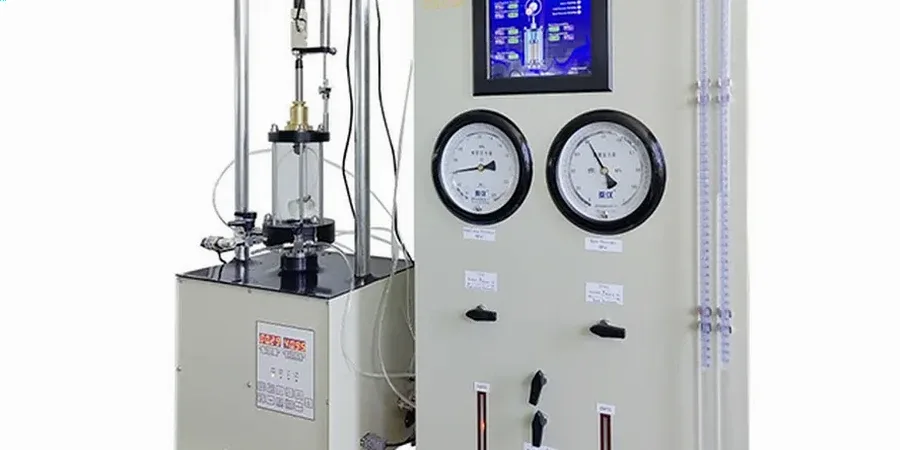
Kansas City’s geotechnical profile shifts abruptly between stiff glacial till, weathered shale, and competent limestone—a reality that demands more than index properties when designing deep excavations or heavily loaded foundations. The limestone bench that supports downtown towers transitions into softer argillaceous layers near the Missouri River bluffs, creating differential settlement risks that only a proper triaxial shear test program can quantify. We run consolidated-undrained (CU) and consolidated-drained (CD) triaxial tests on Shelby tube samples recovered from these transition zones, measuring effective friction angles and cohesion intercepts that feed directly into bearing capacity and slope stability models. With the water table fluctuating seasonally within the alluvial corridor, pore pressure response under load becomes a design-critical parameter that standard unconfined compression cannot capture.
A B-value below 0.95 in low-permeability Kansas City shale means your effective stress path is wrong—and so is your foundation design.
Our approach and scope
Regional considerations
A 14-story mixed-use project over Pennsylvanian shale in the Crossroads Arts District specified deep foundations tied into bedrock, but the initial geotechnical report relied on unconfined compression data that overestimated shear strength by nearly 30%. The driven pile lengths had to be extended after CU triaxial results from the shale contact zone revealed effective friction angles 4 degrees lower than assumed, with a cohesion intercept that dropped sharply at strains beyond 2%. We see this pattern repeatedly when weathered shale is mistaken for intact rock—the triaxial cell applies realistic confining pressures that unconfined tests simply cannot replicate, exposing the true failure envelope before the contractor is committed to an inadequate pile tip elevation. In Kansas City, where bedrock surface topography can undulate 15 feet within a single city block, that level of resolution saves change orders and keeps the project schedule intact.
Relevant standards
ASTM D4767-11: Standard Test Method for Consolidated Undrained Triaxial Compression Test for Cohesive Soils, ASTM D7181-20: Standard Test Method for Consolidated Drained Triaxial Compression Test for Soils, ASTM D2850-15: Standard Test Method for Unconsolidated-Undrained Triaxial Compression Test on Cohesive Soils, IBC 2021 Section 1803: Geotechnical Investigations (referenced for foundation design inputs)
Complementary services
Multi-Stage CU Triaxial Testing
Three confining pressures on a single specimen with pore pressure measurement, ideal for limited-recovery boreholes in Kansas City shale where identical specimens are scarce.
Stress Path Triaxial Programs
Custom loading paths for embankment construction over soft alluvium in the Missouri River floodplain, including K0-consolidation and lateral extension for cut slopes.
Typical parameters
Quick answers
What is the typical turnaround time for a triaxial test program in Kansas City?
A standard three-specimen CU triaxial program with B-value checks and effective stress reporting typically requires 10 to 14 business days from sample delivery. Accelerated schedules are possible when consolidation characteristics allow—contact our lab with your project timeline and we will deliver a schedule aligned with the contractor's submittal milestones.
How much does a triaxial test cost for a Kansas City project?
A CU triaxial program with three effective confining stresses and pore pressure measurement ranges from US$1,680 to US$3,110 depending on specimen preparation difficulty, saturation time, and whether multi-stage or separate specimens are used. We deliver a fixed proposal after reviewing the boring logs and sample conditions.
Which triaxial test type is right for Missouri River alluvium versus weathered shale?
For the normally consolidated silty clays common in Missouri River alluvium, consolidated-undrained testing with pore pressure measurement (ASTM D4767) gives you the undrained shear strength ratio and effective stress parameters needed for both short-term and long-term stability. Weathered shale from the Kansas City Group benefits from a combination of CU for the clay-rich matrix and drained (CD) testing where fractures dominate, since drained parameters control the long-term behavior of cut slopes and retaining structures in these materials.