The most expensive mistake we see in Kansas City retaining wall design is treating the local glacial till and weathered shale like uniform sand. A contractor runs a few shallow borings, assumes a friction angle of 30 degrees, and calls it done. Two years later the wall tilts forward after spring rain saturates the backfill. Kansas City sits on alternating layers of limestone, shale, and clay-rich till that drain poorly and swell with moisture. Wall design here demands site-specific friction angles, cohesion intercepts, and pore pressure assumptions—not textbook defaults. Our lab runs direct shear and triaxial tests on undisturbed samples so the wall geometry actually matches what’s underground. When the backfill includes recycled concrete or shot rock, we cross-check gradation and compaction against grain size analysis to confirm drainage behavior before the first lift goes in.
A retaining wall in Kansas City performs only as well as the interface between compacted fill and weathered rock—that’s where we focus the direct shear program.
Our approach and scope
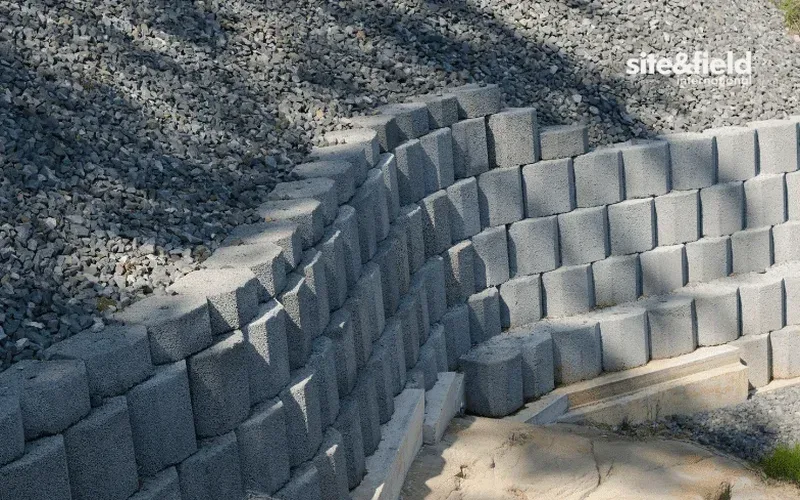
Regional considerations
A ten-story mixed-use building on Grand Boulevard needed a 22-foot permanent soldier pile wall along the south property line. The upper 12 feet were stiff clay with cobbles; below that, jointed limestone with clay seams dipping toward the excavation. During drilling, we found the limestone beds were dipping 15 degrees out of the cut—a setup for wedge failure if the design assumed flat bedding. We ran tilt-table tests and stereonet analysis to define the joint friction angle and wedge geometry. The final wall included 45-foot tiebacks tensioned to 120 kips, with load cells on every third anchor. Six years later the monitoring data shows less than a quarter-inch of total deflection. That wall would have failed without direct measurement of discontinuity orientation and shear strength. In Kansas City, the difference between a stable wall and a lawsuit is often a few degrees of dip that nobody measured.
Relevant standards
IBC 2021 Section 1610 (Soil Lateral Loads), ASCE 7-22 Chapter 3 and Appendix C, AASHTO LRFD Bridge Design Specifications Section 11 (Earth Retaining Structures), ASTM D3080 (Direct Shear) and ASTM D4767 (Triaxial), FHWA GEC 011 (Soil Nail Walls) and GEC 002 (MSE Walls)
Complementary services
Design Parameter Packages
Friction angles, cohesion, unit weights, and modulus values from triaxial and direct shear tests on project-specific samples. Outputs formatted for direct input into WallAP or custom spreadsheets.
Backfill and Drainage Testing
Gradation, permeability, and compaction curves for select backfill. We test drainage aggregate for clogging potential and verify geotextile compatibility with site soils.
Construction Phase Verification
Nuclear density testing on backfill lifts, proof rolling observation, and anchor load testing with calibrated jacks. We confirm that compaction and tension meet the assumptions in the design report.
Typical parameters
Quick answers
What does retaining wall design testing cost in Kansas City?
A typical testing scope for a residential or small commercial wall runs US$920 to US$2,100. Larger projects requiring triaxial testing, multiple boring locations, and anchor verification can range from US$2,500 to US$3,690. We deliver a fixed-price proposal after reviewing the wall height, site access, and geotechnical report requirements.
Do you need a separate report for Kansas City permitting?
Yes. Kansas City requires a geotechnical report addressing lateral earth pressures when walls exceed four feet or retain a surcharge. Our reports follow IBC Section 1610 and include unfactored soil parameters, recommended safety factors, and drainage specifications that satisfy plan reviewers.
How long does lab testing take for a retaining wall project?
Standard tests like classification, Proctor, and direct shear take five to seven business days. Triaxial shear programs with multiple confining pressures add another week. We can accelerate turnaround when foundation excavation dates are approaching.
What backfill material works best behind Kansas City retaining walls?
Clean crushed limestone with less than five percent passing the #200 sieve performs well—it drains freely and develops good friction with geogrids. We test local quarries regularly and can recommend sources. Avoid on-site clay fill unless it is lime-treated and placed in thin lifts with density verification.