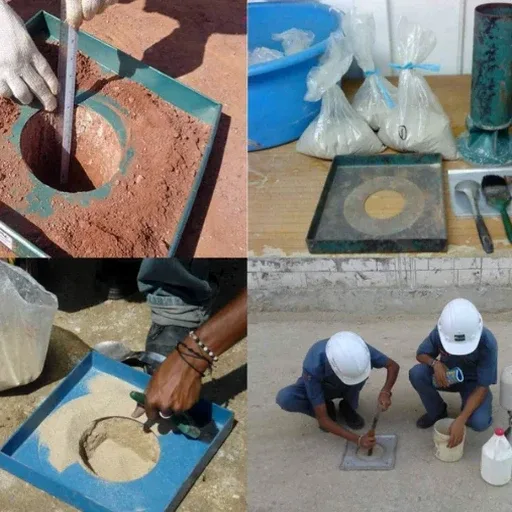
Kansas City sits at roughly 910 feet above sea level, straddling the Missouri River bluffs and the broad floodplain that defines much of Wyandotte and Jackson County development. The 1993 Great Flood reshaped how local engineers approach earthwork—millions of cubic yards of fill had to be placed and compacted afterward, and that kind of work demands verifiable density data. The sand cone field density test remains the most direct method for determining in-place density on compacted granular soils. We run it per ASTM D1556 on residential pads, commercial building pads, utility trench backfill, and roadway subgrade. In a metro area where glacial till, loess, and alluvial sands can all appear on one jobsite, the sand cone gives a single-test verification that correlates directly to Proctor moisture-density curves. For sites where fill thickness exceeds three feet, we often pair the test with SPT drilling to check deeper compaction profiles before structural design proceeds.
A sand cone test takes maybe 15 minutes on site, but that single number often determines whether the next lift of fill gets placed or the compactor makes another pass.
Our approach and scope
Regional considerations
The difference between a site in the River Market area and one out near Lee’s Summit is not just distance—it is geology and compaction behavior. Downtown and the West Bottoms sit on thick alluvial deposits, sand and silt laid down by the Missouri River, where achieving 95% of modified Proctor is generally straightforward if the moisture is right. Move south into the uplands and you hit residual clay over limestone, often with variable moisture pockets that cause the sand cone hole to deform during excavation. The biggest risk in Kansas City field density testing is accepting a passing number from a test where the hole was not properly cleaned, the sand was not calibrated that morning, or the technician ignored a few pebbles that inflated the volume reading. On a structural fill under a mat foundation, a 3% error in density can translate into differential settlement over time. We double-check every questionable result with a second test three feet away; if they disagree by more than 2 pcf, a third test settles the matter. No concrete gets poured until the density log is signed off.
Relevant standards
ASTM D1556 - Standard Test Method for Density and Unit Weight of Soil in Place by Sand-Cone Method, AASHTO T 191 - Density of Soil In-Place by the Sand-Cone Method, ASTM D698 / D1557 - Standard Proctor and Modified Proctor compaction tests (laboratory reference), IBC Section 1804 - Excavation, grading, and fill requirements referencing compaction control
Complementary services
Standard Field Density Test (ASTM D1556)
Single-point in-place density determination using the sand cone method. Includes moisture content, wet and dry density, and percent compaction relative to laboratory Proctor. Deployed on structural fill, trench backfill, and pavement subgrade.
Compaction Curve Development (Proctor)
Laboratory standard or modified Proctor testing (ASTM D698 / D1557) on project-specific soil to establish the maximum dry density and optimum moisture content. The reference curve without which field density numbers have no meaning.
Nuclear Gauge Correlation (ASTM D6938)
When a nuclear density gauge is used for production testing, we perform sand cone correlation tests at a minimum of one per 10 nuclear tests, per Missouri and Kansas DOT specifications, to calibrate gauge readings against the direct sand cone method.
Typical parameters
Quick answers
How does the sand cone test differ from a nuclear density gauge?
The sand cone is a direct volumetric method. You physically excavate soil, measure the hole volume with calibrated sand, and weigh the removed soil. A nuclear gauge estimates density indirectly by measuring gamma radiation attenuation. Sand cone is slower but is the referee method when nuclear gauge results are questionable or when the gauge cannot be calibrated for the specific soil. Agencies like MoDOT and KDOT accept sand cone results as primary evidence of compaction.
What does a field density test cost in the Kansas City area?
A single sand cone field density test typically runs between US$100 and US$130 per point, depending on site location, number of tests per mobilization, and whether laboratory Proctor data already exists. Multiple tests on the same site reduce the per-point cost.
How many sand cone tests are required on a typical building pad?
IBC Section 1804 and local Kansas City Public Works standards generally require one field density test per 1,500 to 2,500 square feet of compacted area per lift, with a minimum of three tests per lift on smaller pads. The exact frequency depends on the geotechnical engineer’s recommendation and the variability of the fill material.
Can the sand cone method be used in wet or frozen soil?
The sand cone method requires the test hole to be stable and the soil to be compactable. In saturated conditions, free water in the hole will displace the calibration sand and produce an erroneously low volume reading. In frozen ground, excavation is difficult and the density value does not represent in-service conditions. We suspend sand cone testing when standing water is present or frost exceeds two inches of penetration.