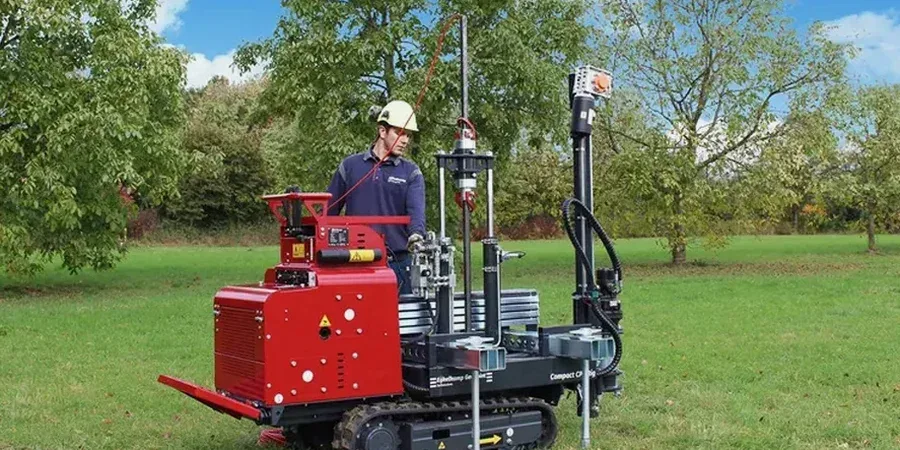
Kansas City sits on a geological patchwork that shifts radically within a few miles. North of the Missouri River you hit thick alluvial clays and loose sands; head south into Johnson County and limestone bedrock rises to within 10 feet of the surface. That contrast matters when you need subsurface data fast. A cone penetration test cuts through both scenarios without cuttings or drilling fluid, logging tip resistance, sleeve friction, and pore pressure every 2 centimeters. Our truck-mounted rig pushes the cone at a steady 2 cm/s, following ASTM D5778 protocols, and delivers a soil behavior type profile before the crew leaves the site. For downtown infill projects where access is tight and noise ordinances apply, the CPT's small footprint and quiet operation beat hollow-stem auguring every time. We run the test across Jackson, Clay, and Platte counties, correlating results with local USGS Quaternary mapping so the geotechnical narrative stays grounded in real stratigraphy.
Continuous CPT data every 2 cm catches thin layers that SPT spoon intervals miss entirely — that's the difference between finding a 4-inch silt seam and walking away without it.
Our approach and scope
Regional considerations
We see a pattern in older Kansas City industrial zones: undocumented fill over buried creek channels. A standard boring might tag top-of-fill and stop, but CPT pore pressure dissipation tests at multiple depths reveal perched water trapped above a low-permeability clay plug — the kind that turns a routine excavation into a sump-pump marathon. Miss that and your shoring design rests on assumed groundwater levels that are flat wrong. Another local trap is the glacial till's erratic boulders. A sudden spike to 40 MPa tip resistance at 15 feet doesn't mean bedrock; it means a cobble the size of a microwave. Knowing when to offset 3 feet and retry, versus calling refusal, takes someone who's pushed cones through Platte County till before. We run dissipation tests at the contract depth and every 20 feet thereafter, because layered alluvium in this region rarely drains uniformly.
Relevant standards
ASTM D5778-20 (CPT/CPTu), IBC 2021 (Site Class per Chapter 16), ASCE 7-22 (Seismic ground motion parameters), FHWA Geotechnical Engineering Circular No. 5 (CPT interpretation)
Complementary services
Seismic CPT with Vs profiling
Add a triaxial geophone module behind the cone to capture true-interval shear wave velocity every 50 cm. Essential for Site Class A through D determination per IBC, and for liquefaction triggering analysis using the Robertson or Boulanger & Idriss methods.
Pore pressure dissipation testing
Stop penetration at target depths and record u2 decay over time to estimate coefficient of consolidation. Critical for settlement-rate predictions in the compressible Missouri River clays that underlie Northland industrial parks.
CPT-to-SPT correlation packages
Generate equivalent N60 values from cone data using regionally calibrated correlations, suitable for shallow foundation design when the structural engineer requires SPT-based bearing capacity charts.
Typical parameters
Quick answers
What does CPT testing cost in Kansas City?
Mobilization plus testing typically runs US$150 to US$280 per vertical meter, depending on depth, access, and whether seismic or dissipation modules are added. A 50-foot sounding with standard CPTu usually falls in the $2,200 to $3,400 range including the digital report.
How deep can you push the cone before hitting refusal?
It depends entirely on the formation. In Missouri River alluvium north of the river, we routinely reach 70 to 80 feet. On the limestone uplands south of I-70, refusal can come as shallow as 8 feet. Our 20-ton rig handles stiff glacial till better than standard 10-ton setups, but solid Bethany Falls limestone stops any cone.
Do I still need a drilling rig if I run CPT?
CPT replaces borings for stratigraphic profiling and liquefaction assessment, but it doesn't recover physical samples. If your project requires moisture content, Atterberg limits, or direct shear testing, we'll coordinate a few targeted SPT borings at key locations alongside the CPT grid.
How quickly do you deliver the CPT report?
Raw logs leave with the field crew. A processed report with corrected cone resistance, friction ratio, soil behavior type classification per Robertson (1986), and pore pressure dissipation curves is emailed within 48 hours. Rush delivery within 24 hours is available for tight permitting deadlines.