Kansas City sits at roughly 910 feet above sea level, straddling the Missouri River bluffs and the broad floodplain below. This elevation change means a single construction site can cut through loess, residual shale, and alluvial clay in the same borehole log. When a soil changes its behavior just by absorbing water, classifying it by grain size alone is a gamble. That is why our Atterberg limits testing is embedded into almost every geotechnical investigation we support in the metro area. The liquid limit and plastic limit give the numbers that feed directly into the Unified Soil Classification System, and from there into bearing capacity tables, swell potential charts, and compaction specs. In a city where clay layers can vary from stiff to slick within five vertical feet, skipping the Atterberg limits can leave a foundation design blind to a critical failure mode.
Atterberg limits turn a handful of clay into a number that predicts how the soil will behave under moisture change — no guesswork, just classification.
Our approach and scope
Regional considerations
Missouri weather does not negotiate with clay. A dry August can shrink Kansas City soils enough to open cracks in the surface; a wet April can turn the same material into a slurry that fails a proof roll. Atterberg limits give the project team a number to hang the risk assessment on. A fat clay with a plasticity index above 35 in the Northland puts a basement wall under lateral pressure that a lean clay would never generate. The shrink-swell potential correlates directly with the plasticity index, and when the PI climbs past 30, the IBC classifies the soil as expansive, triggering special foundation requirements. Ignoring the Atterberg limits in favor of a grain-size-only classification leaves the project exposed to exactly the failure mode that costs the most: moisture-driven volume change that cracks slabs, displaces walls, and turns a signed-off subgrade into a dispute about who missed the clay.
Relevant standards
ASTM D4318 – Standard Test Methods for Liquid Limit, Plastic Limit, and Plasticity Index of Soils, ASTM D2487 – Standard Practice for Classification of Soils for Engineering Purposes (Unified Soil Classification System), IBC Section 1803 – Geotechnical Investigations (expansive soil classification requirements)
Complementary services
Liquid and Plastic Limit Determination
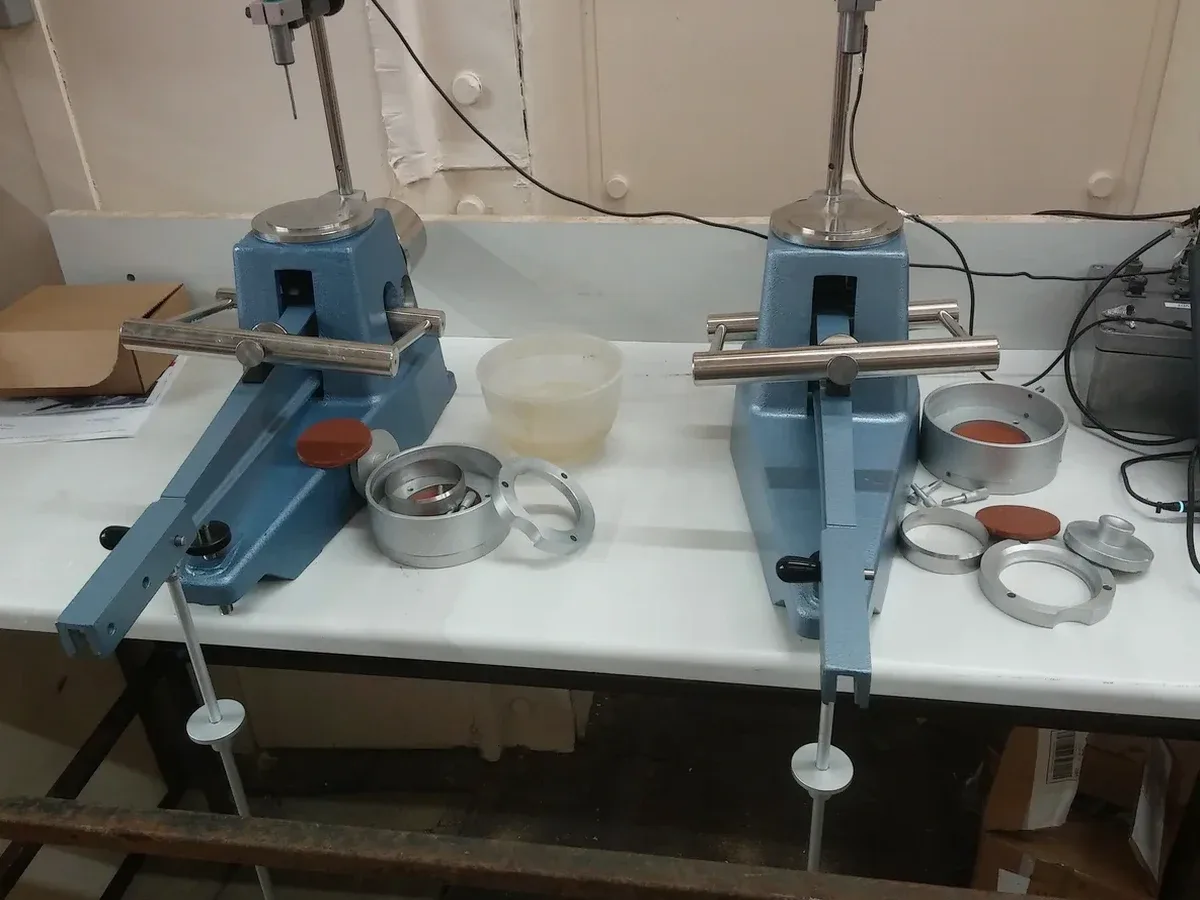
Complete Atterberg limits testing per ASTM D4318 using the Casagrande cup and hand-rolling method. Results include liquid limit, plastic limit, plasticity index, and USCS group symbol.
One-Point Liquid Limit (Correlation Method)
For projects with tight turnaround, we offer the one-point liquid limit procedure using established correlation factors, validated against multipoint data from the same geologic unit.
Shrink-Swell Potential Classification
Using the plasticity index and clay fraction, we classify the soil's expansion potential per IBC criteria, supporting foundation design decisions in Kansas City's expansive clay zones.
Compaction Moisture Target Refinement
We pair Atterberg limits with standard Proctor data to tighten the acceptable moisture range for clay subgrades, reducing the risk of post-construction volume change.
Typical parameters
Quick answers
What is the cost of an Atterberg limits test in Kansas City?
A standard liquid limit and plastic limit determination on a single sample typically runs between US$70 and US$80. The price varies slightly depending on whether a one-point or multipoint liquid limit is required and how quickly results are needed.
How many samples should I send for Atterberg limits testing?
At least one per distinct soil layer encountered in the boring. If the field log shows a color or texture change, sample it. For Kansas City sites that cut through both alluvium and residual shale, two to three samples per borehole is common to capture the clay variability.
Why does the plastic limit matter if I already have the liquid limit?
The plastic limit is the lower boundary of the plastic state. Without it, you cannot calculate the plasticity index, and without the PI, you cannot classify the soil in the USCS or estimate shrink-swell potential. Liquid limit alone tells you where the soil flows; plastic limit tells you where it crumbles.
How long does the Atterberg limits test take?
Oven drying is the pacing step: the sample must dry at 110°C for at least 16 hours. After that, the actual test procedure takes about two hours. Standard turnaround is 48 hours from sample receipt, with 24-hour rush available. More info.