When our field crew arrives at a site in the Northland or along the Missouri River bluffs, the first tool out of the truck is usually a hand auger followed by a SPT rig. Kansas City's variable topography, from the flat bottoms near the Kansas River to the steep limestone cuts along I-35, means every slope is a unique puzzle. We start by logging the overburden, checking for the telltale gray-green shale of the Westerville formation that underlies much of the metro, and measuring the depth to weathered rock. Getting the stratigraphy right from the beginning is what keeps a 40-foot cut from becoming a headache six months later. For deeper investigations, we often pair the SPT work with a CPT test to pick up thin clay seams that the split spoon might miss, especially in the alluvial fills near the West Bottoms. The lab runs point-load tests on the limestone cores the same day they arrive because contractors downtown need answers fast. Understanding the natural bench geometry that the glaciers left behind makes all the difference in a city built on bluffs.
A slope cut into Kansas City shale loses nearly half its peak strength within the first wet-dry cycle. If your analysis uses peak lab values without accounting for softening, the factor of safety is a fiction.
Our approach and scope
Regional considerations
Kansas City's weather is the silent partner in every slope failure. The freeze-thaw cycles from November through March pry open the limestone joints, and then April and May deliver the rainfall that fills those joints and triggers slides. The contrast between the dry, cracked slopes of August and the saturated, creeping slopes of April is something every local geotechnical engineer learns to respect. We saw a 30-foot cut in the Northland move six inches in one week after a five-inch rain event that overtopped a silt fence and saturated the shale bench. That's why our stability reports always include a sensitivity analysis for fully-saturated conditions, even if the site visit happens in a drought. We specify horizontal drains and chimney drains more often than not, because the weathered shale contact acts like a bathtub rim. One overlooked seep at the toe of a slope can trigger a progressive failure that unzips the entire hillside. The Missouri Department of Natural Resources keeps records of landslides in the metro, and the pattern is clear: nearly all of them happen between March and June. Designing for the worst week of the year, not the average conditions, is just standard practice here.
Relevant standards
AASHTO Manual for Bridge Evaluation (slope stability provisions), IBC 2021 Section 1610 (earth pressure and slope stability), ASTM D4644 (slake durability of shales and similar weak rocks), FHWA Geotechnical Engineering Circular No. 5 (GEC 5 - soil nail walls and slopes), MoDOT Engineering Policy Guide, Section 321.3 (slope stability criteria)
Complementary services
Rotational and Translational Failure Analysis
We run limit equilibrium models using Spencer's and Morgenstern-Price methods, calibrated with lab-measured residual friction angles from the local shale. Each analysis includes a back-calculation of historical slope performance where available.
Rockfall Hazard Assessment
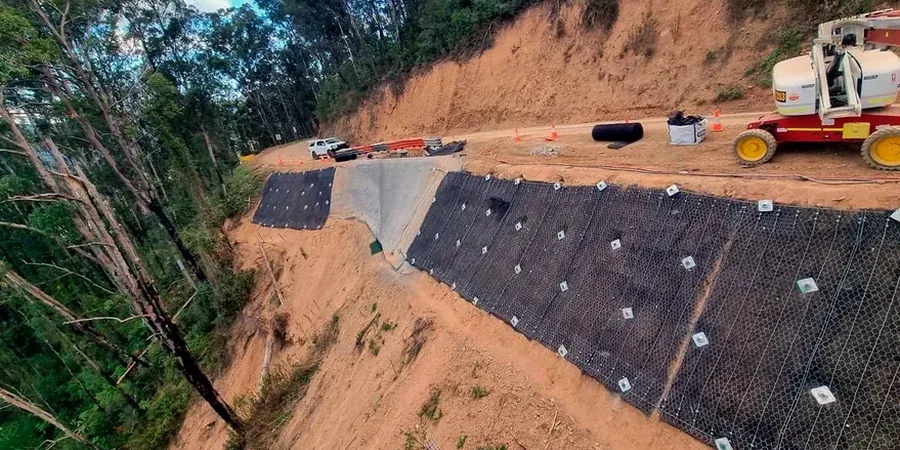
For highway cuts along I-435 and the bluffs in the East Bottoms, we map joint sets, measure persistence, and run kinematic analyses to design catch benches and drape mesh systems per MoDOT guidelines.
Construction-Phase Instrumentation
We install and read slope inclinometers, piezometers, and crack monitors during mass grading operations, providing real-time stability alerts when excavation approaches the critical daylight line.
Typical parameters
Quick answers
What does a slope stability analysis cost for a typical residential lot in Kansas City?
For a typical residential hillside lot in the metro, a slope stability analysis runs between US$1,110 and US$3,870. The spread depends on how many borings we need, whether we have to bring in a drill rig or can use hand equipment, and how complex the stratigraphy is. A simple cut slope with a clean limestone-shale contact costs less; a deep slide with slickensided clays and multiple groundwater zones costs more.
How long does it take to get results after you finish the field work?
The field work usually takes one to three days depending on access. Once the samples hit our lab, we turn around the index testing in three to five business days. The full analysis report, with cross-sections and factor-of-safety calculations, is typically in your inbox within two weeks of completing the borings. We can expedite to one week if the excavator is already on site.
Do I really need a stability analysis for a small cut slope under 15 feet?
In Kansas City, yes, often you do. The combination of stiff limestone over weak shale creates a deceptive condition: the rock looks solid, but the shale underneath can fail and undermine the entire face. We have investigated multiple failures on cuts under 12 feet in the Liberty and Parkville areas. If the slope is steeper than 2H:1V and the shale is exposed at the toe, an analysis is cheap insurance against a slide that could take out a property line or a drainage swale.