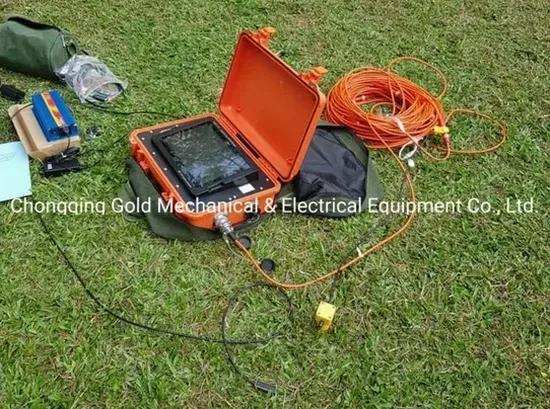
The geophone spread runs 115 meters across the site while the accelerated weight drop strikes the aluminum plate every two meters. That is the rhythm of a seismic refraction survey in Kansas City, where the contact between Pennsylvanian limestone and overlying residual clay creates a velocity boundary that reflection profiling can map within half a meter. The 24-channel seismograph records first arrivals through layers of Warsaw Formation strata, shale partings, and occasional paleokarst voids that plague Missouri River bluff developments. Processing with tomographic inversion software converts travel-time curves into a velocity cross-section, revealing the rockhead profile that governs foundation depth decisions. For deeper targets requiring reflection methods, we deploy a larger source and tighter receiver spacing to image the competent limestone member beneath weathered zones. Complementing the surface wave data, a MASW survey provides shear-wave velocity profiles that feed directly into the IBC site-class determination required by Kansas City building review.
A velocity tomogram with 0.5-meter resolution reveals bedrock topography that a dozen exploratory borings would still miss.
Our approach and scope
Regional considerations
A six-story mixed-use project near the River Market encountered a 4-meter-deep solution cavity during excavation that test borings had completely missed. The limestone at 9 meters showed no indication of the void from the surface, but a subsequent tomographic survey revealed a low-velocity anomaly extending laterally beneath the planned elevator core. That discovery changed the foundation design from spread footings to drilled piers socketed into competent rock below the cavity zone. Kansas City sits atop a karst-prone carbonate sequence where centuries of groundwater circulation have dissolved limestone along joint sets, creating unpredictable void networks. Seismic tomography provides the lateral continuity between boreholes that point data alone cannot offer. Skipping this step in paleokarst terrain risks differential settlement, sudden collapse during excavation, and structural distress that manifests years after occupancy. The IBC explicitly requires investigation of potential geologic hazards, and in the Missouri River corridor, undocumented voids represent one of the most consequential geotechnical risks a project can face.
Relevant standards
ASTM D5777 Standard Guide for Using the Seismic Refraction Method, IBC 2021 Section 1613 Site Classification for Seismic Design, ASCE 7-22 Minimum Design Loads for Buildings and Other Structures, ASTM D7400 Standard Test Methods for Downhole Seismic Testing, KDOT Bridge Design Manual Section 2.4 Geotechnical Investigation
Complementary services
Seismic Refraction Tomography
Multi-shot refraction profiling with ray-based inversion for bedrock mapping, rippability assessment, and IBC site class determination across Kansas City's variable limestone-shale sequence.
Seismic Reflection Profiling
High-resolution CMP reflection surveys for targets deeper than 30 meters, imaging limestone members beneath the Cherokee Group shales with post-stack migration processing.
Crosshole Seismic Testing
Borehole-to-borehole velocity measurements per ASTM D4428 for high-resolution modulus profiling at critical infrastructure sites in the Kansas City downtown corridor.
Karst Void Detection Surveys
Integrated refraction and resistivity grid surveys designed specifically for paleokarst mapping in the Warsaw and Keokuk limestone formations underlying the Missouri River bluffs.
Typical parameters
Quick answers
What depth can seismic tomography reach in Kansas City's limestone geology?
Refraction surveys with a 115-meter spread typically resolve bedrock velocity to 30 meters below grade in our local Pennsylvanian limestone. The depth limit depends on the velocity contrast at the rock interface and source energy. For deeper investigations, reflection profiling using a larger energy source and tighter geophone arrays can image strata beyond 100 meters, though resolution decreases with depth. We also run crosshole seismic tests between cased boreholes when vertical resolution of half-meter layers is required for critical infrastructure.
Can seismic tomography detect sinkholes and solution cavities before excavation starts?
Yes, within resolution limits. Air-filled cavities in limestone produce a strong velocity contrast that appears as a low-velocity anomaly on the tomogram. Clay-filled cavities are subtler but still detectable when correlated with resistivity data. The method images the lateral extent of anomalies between boreholes, which is exactly what point-source drilling misses. For a site near Swope Park with known paleokarst history, we mapped a 6-meter-wide void at 11 meters depth that the geotechnical investigation subsequently confirmed with targeted drilling.
How does seismic refraction determine the IBC site class for our Kansas City project?
The IBC classifies sites A through F based on the average shear-wave velocity in the upper 30 meters, designated Vs30. Seismic refraction provides P-wave velocities that we convert to shear-wave profiles using established Poisson ratio assumptions for our local soils. Alternatively, MASW or downhole seismic testing measures Vs directly. The resulting Vs30 value determines the site class, which directly affects the seismic design forces required by ASCE 7 and enforced by Kansas City building permit review.
What is the typical cost range for a seismic tomography survey in the Kansas City area?
Seismic tomography surveys in Kansas City generally range from US$2.810 to US$4.900 depending on the array length, number of shot points, target depth, and site access conditions. A basic refraction line with 24 geophones and 12 shot points for bedrock mapping falls at the lower end, while a full grid with reflection processing and crosshole correlation reaches the upper range. Each proposal includes a detailed mobilization breakdown, processing time, and deliverable specifications.