Kansas City sits on a geological puzzle. North of the Missouri River, you hit glacial tills and loess bluffs. South of the river, mississippian limestone and shales dominate, often with a thin veneer of residual clay. We've pulled Shelby tube samples from downtown sites where the bedrock is three feet down, and from Overland Park jobs where highly plastic clay extends thirty feet before hitting anything competent. This variability means generic bearing pressure tables won't cut the mustard. Our shallow foundation design work starts with proper subsurface characterization, because a footing that works in Clay County can fail in Johnson County. We regularly pair borings with CPT testing to map the transition between stiff residuum and weathered bedrock without losing the stratigraphic detail that standard penetration tests alone can miss in this kind of transitional profile.
In Kansas City, we design footings for settlement, not bearing capacity. The limestone is never as shallow as the GPR says it is.
Our approach and scope
Regional considerations
We inspected a warehouse expansion near the Kansas River in Argentine district where the contractor poured strip footings without a geotechnical report. The soil report they ignored showed fat clay with PI values over 40. Within eighteen months, differential heave cracked the slab in three places and racked the steel columns out of plumb by two inches. The fix involved underpinning twelve columns and injecting polyurethane grout under the slab. Total repair cost exceeded the original foundation budget. Kansas City's expansive clay problem is not theoretical. It shows up in building department records every spring. The risk compounds when you add mature trees near the footprint, because root desiccation creates shrinkage zones that a uniform mat foundation cannot bridge without deepened edge beams. We detail perimeter beams at least 30 inches deep on any site with cottonwoods or silver maples within the influence zone.
Relevant standards
IBC 2021 - Chapter 18 Soils and Foundations, ASCE 7-22 - Minimum Design Loads for Buildings and Other Structures, ASTM D2487 - Standard Practice for Classification of Soils for Engineering Purposes (Unified Soil Classification System), ASTM D1586 - Standard Test Method for Standard Penetration Test (SPT) and Split-Barrel Sampling of Soils, ACI 318-19 - Building Code Requirements for Structural Concrete (footing reinforcement provisions)
Complementary services
Spread Footing Design
Isolated and combined footing design for commercial and industrial buildings. Includes eccentric loading checks, sliding stability, and frost depth compliance at 30 inches minimum cover per KCMO code.
Mat Foundation Design
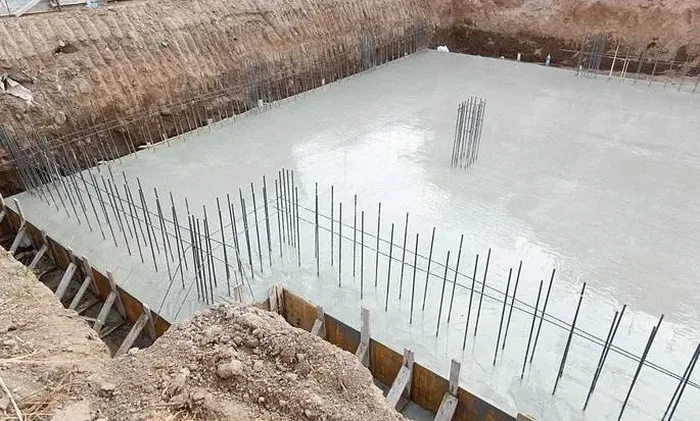
Full-building mat analysis using subgrade reaction modulus derived from in-situ plate load testing. We model differential settlement across the footprint and specify thickened edge zones for expansive soil sites.
Construction Support
Subgrade inspection during excavation, proof-rolling verification, and compaction testing. We witness rebar placement and issue foundation completion reports for the building department file.
Forensic Foundation Assessment
Investigation of existing foundation distress including crack mapping, elevation survey, and soil sampling to determine causation of heave or settlement. Used by insurance adjusters and litigation teams.
Typical parameters
Quick answers
What does shallow foundation design cost for a typical Kansas City commercial building?
For a single-story commercial project up to 10,000 sq ft, the geotechnical investigation and foundation design package typically ranges from US$1,660 to US$2,970, depending on the number of borings required and whether a mat or spread footing system is analyzed. This includes the soil report, bearing capacity calculations, and construction drawings coordination.
How deep do footings need to be in Kansas City to avoid frost heave?
Kansas City building code requires a minimum footing depth of 30 inches below finished grade for frost protection. However, on expansive clay sites we often recommend 36 inches minimum to reduce moisture fluctuation effects near the surface, which can cause seasonal heave independent of frost action.
Can you design a shallow foundation directly on limestone bedrock?
Yes, and it is common in the downtown Kansas City area where bedrock is shallow. We verify rock quality with RQD measurements from core borings. If the limestone is competent and free of solution cavities, we design footings bearing directly on the cleaned rock surface with a minimum bearing pressure of 8,000 psf, per IBC presumptive values.
What is the difference between a mat foundation and a spread footing in terms of settlement control?
A mat foundation distributes building loads across the entire footprint, reducing differential settlement on sites with variable soil stiffness. Spread footings are discrete pads under each column, and on Kansas City's alluvial clay deposits they can settle at different rates if the underlying soil profile changes across the site. We recommend mat foundations when more than three columns show settlement predictions exceeding 0.75 inches of differential movement.