With a metropolitan population exceeding 2.3 million and infrastructure stretching across the clay-rich bluffs of the Missouri River, Kansas City demands rigorous pavement engineering. The laboratory CBR test remains the backbone of flexible pavement design under AASHTO 93 methodology, and our Kansas City lab runs these assays daily for DOT, commercial, and residential projects. Whether it is a warehouse off I-435 or a subdivision in Overland Park, the soaked CBR value determines the structural number of the base and asphalt layers. We process samples from depths matching the local subgrade, where weathered shale and fat clays can produce CBR values as low as 2 percent if not properly stabilized. For projects requiring field correlation, our technicians often pair the lab CBR with in-situ density verification using the sand cone method to confirm compaction targets during construction. The Kansas City metro, with its freeze-thaw cycles and expansive soil pockets in Johnson County, requires both standard and modified Proctor-compacted specimens to simulate worst-case moisture conditions.
A soaked CBR below 3 percent in Kansas City fat clays often triggers lime stabilization before any aggregate base is placed.
Our approach and scope
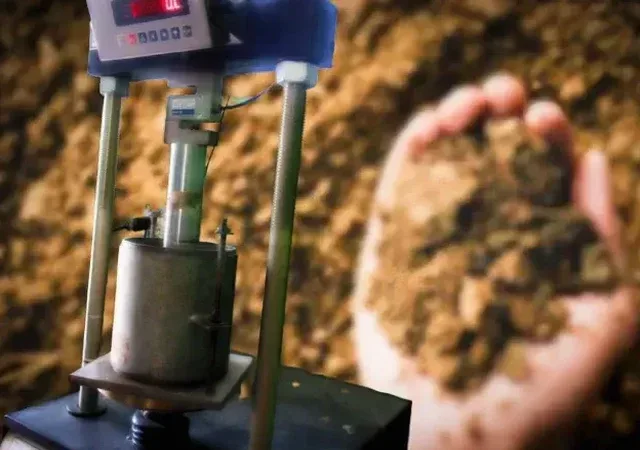
- Soaked CBR after 96-hour immersion per ASTM D1883
- Unsoaked CBR for immediate post-construction evaluation
- Surcharge weights simulating overlying pavement mass
- Swell percentage measurement during soaking
- Load-penetration curve analysis with correction for concavity
Regional considerations
A common mistake among contractors in the Kansas City region is accepting a single CBR value from a shallow bulk sample to design the entire pavement section. The local stratigraphy, with its interbedded limestone ledges and clay seams, requires CBR determination for each distinct soil unit encountered in the boring log. When a design relies on an unrepresentative CBR of 15 from a lean clay lens while the underlying fat clay registers a soaked CBR of 2.5, the pavement will track record differential rutting within the first two seasonal cycles. The Missouri Department of Transportation and KDOT both require minimum CBR thresholds for subgrade acceptance, and failing to meet them leads to costly undercutting and re-compaction after the grade has already been proof-rolled. Our laboratory provides a CBR profile tied to the geotechnical boring log, so the design engineer can specify variable base thicknesses across the alignment. This prevents the expensive call-back where a pavement section, designed for a CBR of 10, fails over a subgrade that never exceeded 3 in the first place.
Relevant standards
ASTM D1883: Standard Test Method for California Bearing Ratio (CBR) of Laboratory-Compacted Soils, AASHTO T 193: The California Bearing Ratio, ASTM D1557: Standard Test Methods for Laboratory Compaction Characteristics of Soil Using Modified Effort, ASTM D698: Standard Test Methods for Laboratory Compaction Characteristics of Soil Using Standard Effort, ASTM D2487: Standard Practice for Classification of Soils for Engineering Purposes (Unified Soil Classification System), AASHTO Guide for Design of Pavement Structures (1993)
Complementary services
Subgrade Resilient Modulus Estimation
Using established AASHTO correlations between soaked CBR and resilient modulus (Mr), we deliver Mr estimates for Level 2 and Level 3 ME pavement design inputs, calibrated for the fine-grained soils typical of the Kansas City metro.
Lime and Cement Stabilization Mix Design
When the laboratory CBR falls below the subgrade acceptance threshold, we perform pH-based lime demand tests and unconfined compressive strength trials to develop a stabilization mix that raises the CBR above the required minimum before paving.
Typical parameters
Quick answers
What does the laboratory CBR test cost in Kansas City?
A standard laboratory CBR test on a single remolded specimen, including modified Proctor compaction and 96-hour soaking, runs from US$120 to US$230 per point in the Kansas City area. The price varies with the number of points tested per project and whether surcharge weights need to be fabricated for unusual pavement sections. Most pavement investigations require a minimum of three CBR points to capture subgrade variability across the site.
How long does a soaked CBR test take from sample delivery to report?
The full procedure requires compaction, a 96-hour soaking period, and then the penetration test, followed by data reduction. Standard turnaround in our Kansas City lab is seven to eight calendar days. Expedited processing with overnight soaking and same-day penetration can deliver preliminary results in five days, though the 96-hour soak remains the AASHTO standard for design.
Can you run CBR tests on aggregate base material or only on subgrade soil?
We test both. For unbound granular base and subbase materials, the CBR procedure is modified to account for larger particle sizes, and we often run the test unsoaked to represent the free-draining behavior of crushed limestone aggregate commonly sourced from local Kansas City quarries. Soaked CBR on aggregate is less common but can be performed when drainage is uncertain.
What CBR value does the Missouri DOT require for subgrade acceptance?
MoDOT typically requires a minimum soaked CBR of 6 to 10 for untreated subgrade under flexible pavements, depending on the traffic classification. Values below that threshold trigger mandatory stabilization or undercut and replacement. Our laboratory reports include the swell percentage and moisture content at compaction, both of which MoDOT inspectors review during grade approval.