The Missouri River carved a deep alluvial valley right through the heart of Kansas City. Most of downtown sits on 20 to 40 feet of soft, compressible clay and silt before you hit bedrock. That layering shows up in every borehole log we produce. When a new warehouse in the West Bottoms or a mid-rise near the Plaza needs foundation parameters, the Standard Penetration Test gives us the N-values engineers actually trust. We run CPT testing on sites where continuous profiling makes more sense, and test pits when the upper 15 feet need a direct visual log. But SPT remains the backbone for most Kansas City jobs because it pairs sample recovery with resistance data in one go.
An N-value without an energy correction is just a number. The difference between a safety hammer and an auto-trip hammer can shift your bearing capacity estimate by a third.
Our approach and scope
Regional considerations
The Northland and the bottoms floodplain behave like two different cities from a geotechnical standpoint. Sites in the Missouri River bottoms often have 30-plus feet of soft clay with N-values in the 2 to 4 range. That soil is going to settle under any load, and the SPT numbers will tell you exactly where the weak zone bottoms out. Move ten miles north into the till country around Liberty and you are hitting N-values of 25 or higher within 10 feet of the surface. The risk profile flips completely. The biggest mistake we see is contractors applying a single foundation type across a multi-site development without running SPT borings at each parcel. The limestone bedrock surface across the metro is irregular and karstic in places. A refusal at 12 feet on one lot does not mean your neighbor's lot has rock at the same depth. Three borings minimum per building footprint, spaced to catch that variability. When we suspect liquefiable sands below the water table, the SPT data feeds directly into the liquefaction assessment analysis using the Seed-Idriss simplified procedure.
Relevant standards
ASTM D1586 Standard Test Method for Standard Penetration Test (SPT) and Split-Barrel Sampling of Soils, ASTM D2487 Standard Practice for Classification of Soils for Engineering Purposes (Unified Soil Classification System), IBC 2021 Section 1803 Geotechnical Investigations, ASCE 7-22 Minimum Design Loads and Associated Criteria for Buildings and Other Structures
Complementary services
Subsurface SPT Boring Program
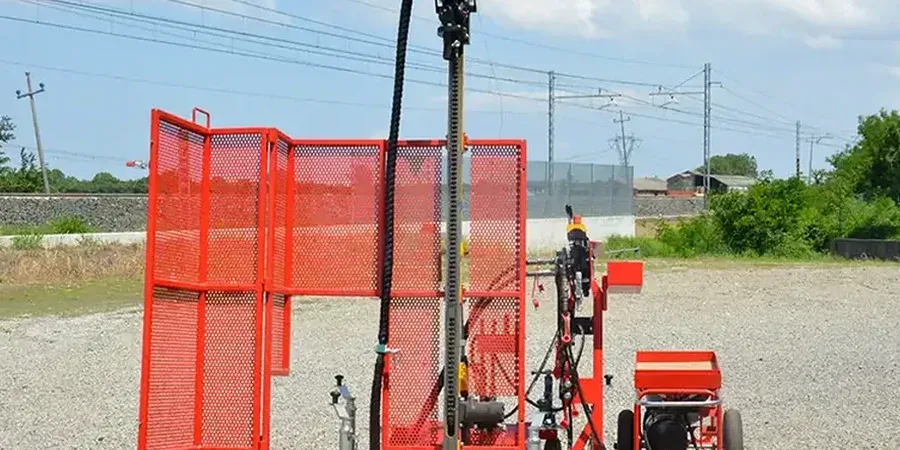
Mobilizing truck-mounted or track-mounted drill rigs across the KC metro. We log blow counts every 5 feet, recover split-spoon samples, and record groundwater depth. Standard depth 40 feet, deeper on request for high-rise or bridge work.
N60 Energy-Corrected Reporting
Every SPT log includes raw N-values and N60 corrected values. We document hammer type and energy ratio on the log header. This data feeds directly into bearing capacity and settlement calculations without the structural engineer having to guess at corrections.
Soil Classification Package
SPT samples go to our lab for visual classification, moisture content, and Atterberg limits where fine-grained soils are encountered. We issue a combined boring log with USCS classifications tied to each sampling depth per ASTM D2487.
Typical parameters
Quick answers
What does SPT testing cost for a standard residential lot in Kansas City?
For a single-family lot with two borings to 25 feet, SPT testing in the Kansas City area typically runs between US$550 and US$780 per boring depending on access conditions and drilling depth. Sites with difficult access, steep slopes, or requiring track-mounted equipment push toward the upper end. A full report with N60 corrections, soil classification, and bearing capacity recommendations is included.
How many SPT borings does the IBC require for a commercial building in Kansas City?
IBC 2021 Section 1803 does not prescribe a fixed number. It requires enough borings to characterize soil variability across the footprint. For a typical Kansas City commercial building under 50,000 square feet we recommend three to five borings spaced to cover the corners and center. Sites near the Missouri River floodplain or in karst areas south of the river may need closer spacing because bedrock depth can change sharply over short distances.
What depth do SPT borings need to reach in the Kansas City area?
It depends on the project and the geology. For a two-story structure on the upland limestone formations of Johnson County, 25 to 30 feet is usually sufficient. For a mid-rise in the river bottoms where soft alluvial clay extends deeper, we often go to 50 feet or until we hit refusal on bedrock. The IBC requires borings to extend deep enough to pass through all unsuitable bearing strata and into competent material.