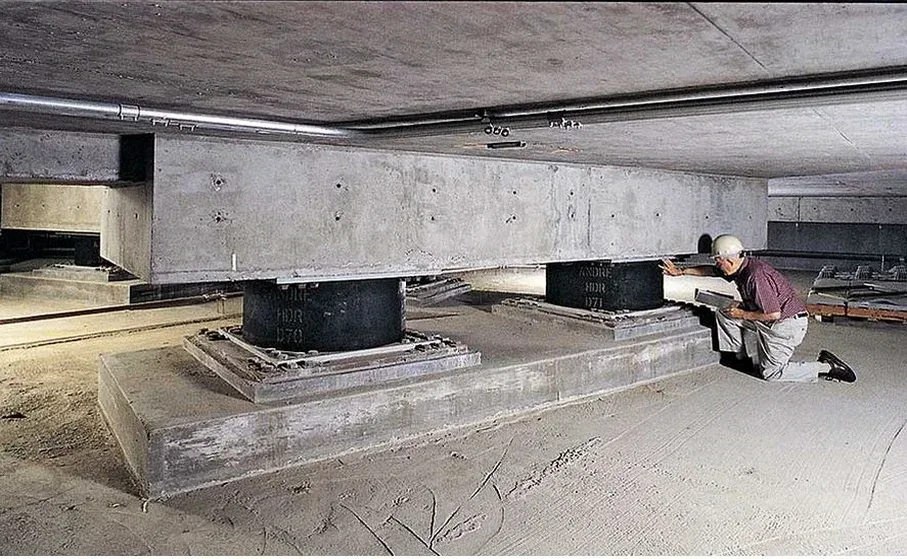
One of the costliest mistakes we still see on Kansas City projects is a direct fixed-base design on the deep alluvial clays of the Missouri River bottoms. The structural engineer runs the modal analysis, gets a base shear number, and designs the lateral system without ever checking if the soil profile amplifies ground motion. In the West Bottoms or anywhere near the floodplain, that oversight can double the actual seismic demand compared to what the code assumes. A proper base isolation seismic design decouples the superstructure from the ground, shifting the fundamental period away from the soil’s amplification peak. Our team in Kansas City works with the ASCE 7 Chapter 17 framework to model elastomeric and friction pendulum systems that cut interstory drift by up to 40% on Class E and F sites. When the subsurface data from an Spt Drilling campaign confirms a soft clay profile deeper than 30 feet, isolation becomes a cost-effective alternative to overdesigning the foundation.
On Kansas City soft soil sites, base isolation shifts the structural period beyond the 0.8 to 1.5-second amplification band, cutting base shear by one-third to one-half.
Our approach and scope
Regional considerations
Kansas City’s urban expansion into the Missouri River valley after the 1951 flood changed the geotechnical risk profile for every major structure built there since. Levees and floodwalls allowed development on deep compressible deposits that had never supported heavy structures before. The 1951 event itself was a wake-up call, but the engineering response focused on flood protection, not seismic performance. Today, the USGS hazard maps show a 2% probability of exceedance in 50 years for peak ground accelerations near 0.10g to 0.15g on rock, amplified to 0.25g or higher on the soft valley soils. A fixed-base hospital or data center on those soils risks resonance with long-period basin effects that a standard code spectrum does not capture. Base isolation seismic design addresses this by engineering a predictable, low-frequency response. The isolators absorb displacement demand while protecting nonstructural components—the biggest source of downtime losses in a Midwest earthquake.
Relevant standards
ASCE/SEI 7-22 Chapter 17: Seismic Isolation, IBC 2021 Section 1705.13: Special Inspections for Isolated Structures, ASTM D1586: Standard Penetration Test for Subsurface Characterization, ASTM D2487: Unified Soil Classification for Site Class Determination
Complementary services
Site-Specific Hazard and Soil Amplification Study
We develop the MCE and DE spectra for the Kansas City site using boring logs and shear wave velocity profiles, incorporating basin effects where the alluvium exceeds 30 meters depth.
Isolator System Design and Nonlinear Modeling
We select and model lead-rubber, high-damping rubber, or friction pendulum isolators with bilinear properties tuned to the structure’s weight and the site’s period range.
Peer Review and Special Inspection Support
We prepare the isolation design report required by IBC Chapter 17 and support the special inspection agency during prototype testing and production quality control.
Typical parameters
Quick answers
At what building height does base isolation become cost-effective in Kansas City?
The reference range for this service in Kansas City is US$3.710 - US$7.530. The final price depends on the project scope and volume.
What is the typical cost range for a base isolation design study on a mid-rise Kansas City project?
A complete isolation design package—hazard analysis, isolator property selection, nonlinear modeling, and the IBC-required peer review report—typically falls between US$3,710 and US$7,530 for a mid-rise structure, depending on the number of ground motion pairs and the complexity of the superstructure model.
How do you verify isolator performance during construction?
IBC Section 1705.13 mandates prototype testing of two full-scale isolators per type, plus production tests on every manufactured unit. We specify the test protocol—vertical load, lateral displacement cycles, and scragging recovery—and review the lab reports against the design properties before installation.
Does Kansas City’s seismicity justify isolation, or is it over-engineering?
The USGS hazard for Kansas City is moderate, but the soft soil amplification in the river corridor can push spectral accelerations into the range where isolation makes economic sense. For critical facilities—hospitals, emergency operations centers, data centers—the downtime avoided after a 475-year event often covers the isolator cost in the first loss scenario.