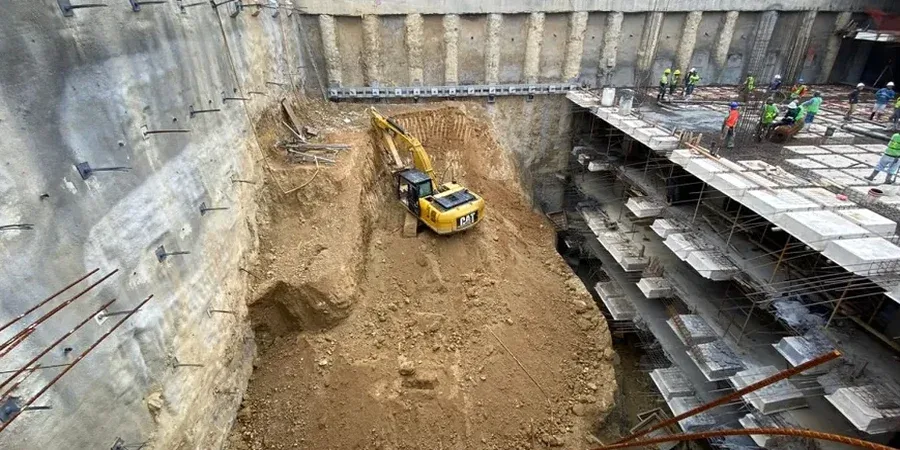
In Kansas City, many projects hit limestone unexpectedly within the first 15 to 20 feet, especially east of Troost Avenue. Designing a deep excavation here without local stratigraphic context invites costly delays. The Pennsylvanian-age bedrock alternates between competent limestone and weaker shale layers, creating irregular bearing surfaces. We have seen urban sites near the Missouri River where alluvial deposits mask variable bedrock depth by more than 10 feet across a single city block. A safe excavation plan requires more than generic shoring; it demands correlation with local water table data and an understanding of how weathered shale loses strength upon exposure. Before the first bucket is dug, integrating a CPT test helps resolve stratigraphy where core recovery is poor, and reviewing slope stability principles becomes critical when the cut face must remain open for weeks during foundation work.
In Kansas City, the distance between competent rock and weathered shale can be measured in inches, not feet—that's what governs the excavation support design.
Our approach and scope
Regional considerations
Soil conditions shift abruptly as you move from the Missouri River bottoms in North Kansas City toward the bluffs in Quality Hill. In the bottoms, thick compressible alluvium demands careful base stability checks; a basal heave failure can develop quickly if pore pressures are underestimated. On the bluffs, the risk shifts to rockfall and wedge failure where limestone beds are undercut by weaker shale. We have observed excavation walls in the Crossroads district where daylighting a slickensided shale seam caused a 3-inch lateral movement in less than 48 hours. Another frequent problem across the Metro is uncontrolled groundwater inflow from perched aquifers within the limestone fractures. Without pre-treatment via grouting or a solid dewatering system, these inflows can saturate the retained soil mass, increase lateral loads beyond design values, and compromise worker safety at the bottom of the cut.
Relevant standards
IBC 2021 (International Building Code, Chapter 18), ASCE 7-22 (Minimum Design Loads for Buildings and Other Structures), ASTM D1586 (Standard Penetration Test), ASTM D2487 (Classification of Soils for Engineering Purposes), OSHA 1926 Subpart P (Excavations)
Complementary services
Excavation Support Design
We develop anchored, cantilever, and strutted wall designs for cuts up to 80 feet deep, addressing mixed ground conditions common in the Kansas City metro.
Dewatering and Groundwater Control
Design of deep well and wellpoint systems that handle perched water in limestone fractures and high water tables near the Missouri and Kansas Rivers.
Instrumentation and Monitoring Plans
Plans specifying inclinometers, piezometers, and settlement points to track wall deflection and pore pressure during construction in urban Kansas City environments.
Constructability and Peer Review
Independent review of excavation submittals and staged construction sequencing to ensure compliance with IBC and local Kansas City building department requirements.
Typical parameters
Quick answers
What is the typical cost range for a deep excavation design in Kansas City?
The fee for a comprehensive geotechnical design of a deep excavation in the Kansas City area typically falls between US$2,180 and US$9,370. The final cost depends on the excavation depth, the complexity of the ground profile (especially if limestone pinnacles or multiple shale seams are present), and the level of instrumentation required.
How do you handle the variable bedrock surface common in Kansas City?
We use a combination of exploratory borings and, where necessary, geophysical methods to map the rock surface. The support system is then designed for the worst-case profile, often with adjustable anchor lengths or staged excavation levels to accommodate the actual rock line encountered during construction without compromising wall stability.
Which building code governs deep excavation design in Kansas City?
The International Building Code (IBC) Chapter 18 governs excavation, grading, and fill. We also follow ASCE 7 for load combinations and OSHA Subpart P for safety requirements. Our designs are prepared to meet the plan review standards of the applicable jurisdiction within the Kansas City metropolitan area.