When a new structure rises in Kansas City, the first challenge lies hidden beneath the surface. The region's geological profile, shaped by alternating layers of limestone, shale, and expansive clay, demands a precise soil mechanics study before any foundation is poured. Kansas City straddles the Missouri-Kansas state line, and the variability in subsurface conditions across the metro area can change within a single block. An accurate soil mechanics study transforms these unknowns into predictable engineering parameters, allowing structural designers to account for differential settlement and seasonal volume changes. The team applies ASTM D2487 classification protocols and triaxial shear testing to deliver data that directly feeds into foundation design. For deeper stratigraphy where bedrock is suspected, we often recommend a complementary CPT test to profile continuous resistance without disturbing the sample, which is particularly useful in the alluvial deposits near the Missouri River bottoms.
The difference between a foundation that lasts 50 years and one that fails in 10 starts with understanding the soil's stress-strain behavior under saturated conditions.
Our approach and scope
Regional considerations
The limestone bedrock that gives Kansas City its solid reputation also introduces the most overlooked hazard: karst dissolution features. Subsurface voids can remain undetected for decades until a load-bearing column punches through a thin roof, a failure mode that no amount of structural redundancy can overcome without prior geophysical investigation. In the Northland and areas east of I-435, where glacial till overlies weathered shale, the risk shifts to slope creep and progressive failure in overconsolidated clays that lose strength when wetted. A soil mechanics study that omits laboratory testing on remolded samples risks underestimating long-term settlement and lateral earth pressures. The IBC and local Kansas City building code require a geotechnical report addressing these specific failure modes. We routinely pair the soil mechanics study with seismic refraction surveys to map bedrock topography and identify potential void zones before drilling begins, which reduces the probability of encountering unexpected karst features during construction.
Relevant standards
ASTM D1586 Standard Test Method for Standard Penetration Test (SPT) and Split-Barrel Sampling of Soils, ASTM D2487 Standard Practice for Classification of Soils for Engineering Purposes (Unified Soil Classification System), ASTM D2435 Standard Test Methods for One-Dimensional Consolidation Properties of Soils Using Incremental Loading, ASCE 7 Minimum Design Loads and Associated Criteria for Buildings and Other Structures, International Building Code (IBC) Chapter 18: Soils and Foundations, as adopted by Kansas City, MO
Complementary services
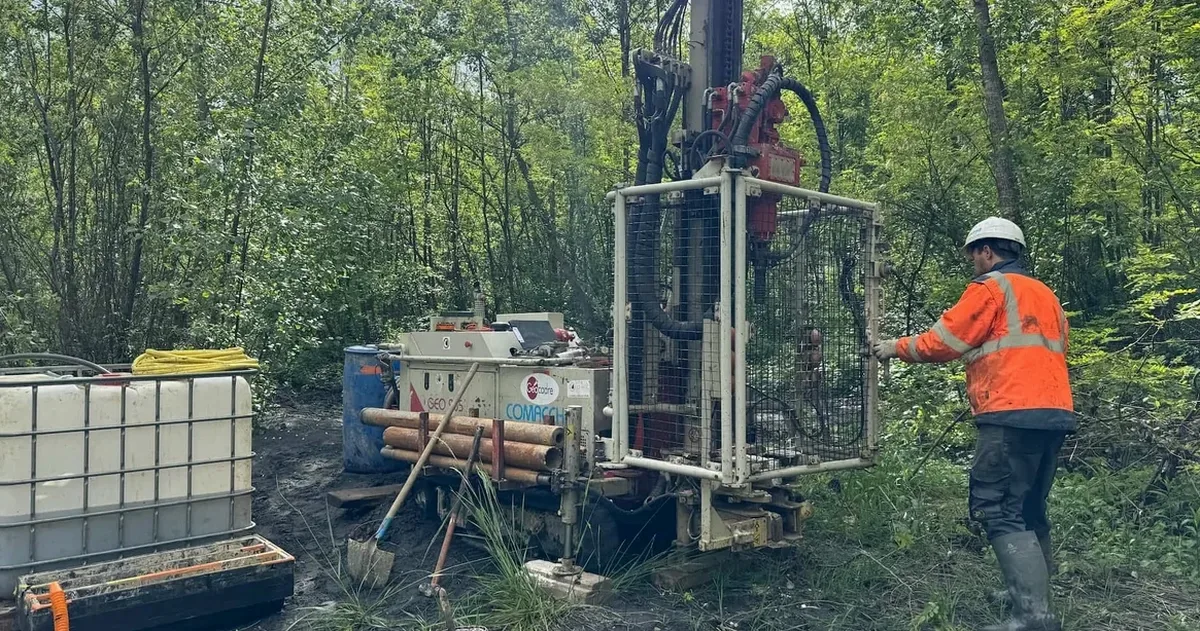
Subsurface Drilling & Sampling
Rotary wash and hollow-stem auger drilling across Kansas City's variable geology, recovering disturbed and undisturbed samples for laboratory index and strength testing.
Advanced Laboratory Testing
Triaxial compression (consolidated-undrained and drained), consolidation, swell, and chemical testing to quantify the mechanical behavior of local Pennsylvanian-age soils and weathered rock.
Foundation Design Parameters
Interpretative report delivering allowable bearing capacity, anticipated total and differential settlement, lateral earth pressure coefficients, and slab-on-grade subgrade modulus values.
Karst & Void Mitigation Analysis
Integration of geophysical survey data with rock coring to assess sinkhole risk and recommend grouting or deep foundation alternatives for limestone cavity zones.
Typical parameters
Quick answers
How long does a typical soil mechanics study take for a Kansas City commercial building site?
For a standard commercial lot in Kansas City, the field drilling phase usually takes two to three days, with laboratory testing extending the schedule to roughly three weeks from mobilization to final report delivery. Sites requiring deeper bedrock coring or extensive consolidation testing on saturated clays may add another week, as drained triaxial tests require longer pore pressure equilibration times.
What is the approximate cost range for a soil mechanics study in the Kansas City metro?
A complete soil mechanics study for a typical commercial project in Kansas City falls between US$3,120 and US$4,500, depending on the number of borings, laboratory test complexity, and whether rock coring is required. Projects involving karst investigation with geophysical surveys will trend toward the upper end of that range due to the additional data integration work.
Which ASTM standards govern the laboratory testing for our project?
The laboratory program is conducted under ASTM D2487 for soil classification, ASTM D1586 for SPT correlation, ASTM D2435 for consolidation properties, and ASTM D4546 for swell and collapse potential. For shear strength, we run ASTM D2850 (unconsolidated-undrained) or ASTM D7181 (consolidated-undrained triaxial) depending on the drainage conditions expected during construction and service life.
Can a soil mechanics study identify if our site has a sinkhole risk?
A thorough soil mechanics study identifies karst susceptibility through a combination of rock core recovery analysis, fracture spacing measurement, and stratigraphic profiling. When limestone pinnacles and solution-weathered zones are encountered, we integrate the geotechnical data with a seismic refraction survey to map the bedrock surface topography and detect potential void zones before foundation design proceeds.